
Groundhog’s Day
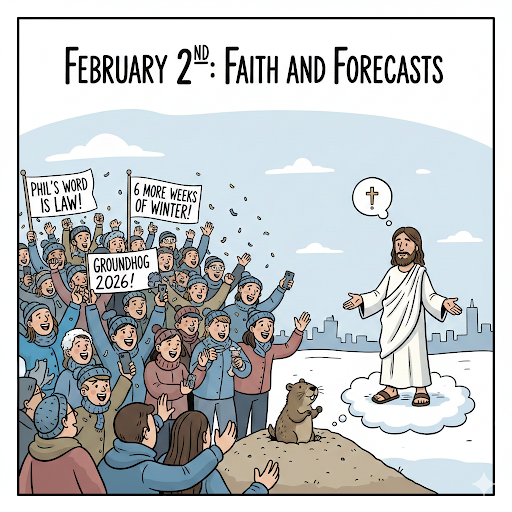
Apparently, today is Groundhog’s Day…
Nearly 58% of Americans say they trust the groundhog, Phil’s, prediction for the arrival of spring. It draws millions of viewers online and last year they had a record breaking attendance for the in-person event in Pennsylvania, 55,000 people.
The most recent statistic, that I found from 2023, said that only 20% of Americans believe that the Bible is the Word of God (down from 30% in 2002). In the same breath, about 49% believe it's a collection of fables and history instead. 53% of Americans believe that Jesus was real and a great teacher, but not God.
Statistics for this are pretty back and forth and have many variations such as polling Americans to see if they're christian and of the ones saying yes, further asking if they believe Jesus was God, or if they believed the Bible is more of an instruction manual versus a story.
However, it's fairly clear that Americans are statistically more willing to trust a rodent emerging from a hole to predict seasonal weather than to trust a 2,000-year-old text that has shaped law, ethics, literature, and entire civilizations.
I have a growing list of questions in my brain:
➡️What qualifies something as “credible”? I know the literal definition and academically what credibility requires, but based on individual perspective, what are the qualifications? Repetition? Tradition? Cultural ritual? Emotional comfort? Entertainment value? A social consensus??
➡️Why exactly is symbolic belief acceptable in folklore but suspicious in theology?
Groundhog’s Day = tradition + fun → safe 👍
Scripture = tradition + moral authority → threatening (?) 👎
➡️Is personal disbelief ACTUALLY about evidence, or is it more about authority?
Because if you think about it, a groundhog asks nothing of us and makes no demands, Scripture does.
➡️Why is “Jesus as a great teacher” palatable to humans, but “Jesus as God” intolerable to many? Is it because viewing Jesus as only being a teacher is easy and really only requires admiration.
The other, believing that He is God, would be admitting and accepting that His commands aren't suggestions, they require a response from us and for many it is a perceived loss of autonomy?
Just from my readings and gathered data, it appears that the threshold for belief is not “evidence" at all, but “low personal cost.”
➡️Is there a correlation between the declining belief in transcendent meaning and rising rates of anxiety, depression, and identity confusion?
I am not saying “disbelief causes mental illness,” but instead whether humans function better when reality has meaning beyond themselves (personally, it feels true and I would agree to that...but I'm interested in the very specific numbers).
I am biased, but it does seem that low-stakes myths are comforting to humans, while high-stakes truth is inconvenient. I am just a bit confused by the hierarchy of trust.
But then again, the idea of something being "high-stakes" makes me question that perceived definition because 62% say they've gambled in some form (with sports bets being pretty high) in the last 12 months.
I'm not sure... it just seems like there are some very confusing concepts to understand. At least to me. Interesting, but odd and slightly concerning.