
Personal Relationship with God
Here I am, back at this coffee shop in Los Osos, California with a few hours to study before my family picks me up to go body boarding. They headed to San Luis Obispo for an afternoon of snacking and shopping.
I’m becoming less and less interested in window shopping when I don’t need anything or eating when I’m not hungry. When I AM hungry, that’s a different story. When I’m hungry, I’m very interested in eating, but what I eat is of less consequence these days.
I spent decades chasing cravings and then mentally and emotionally spinning about how to deal with the consequences (extra pounds). Now when I sense I’m hungry, I look for the most nutrient packed readily available option, eat and move on.
I’m thankful for the abundance of food in our society, but I am equally disturbed by how prone we as a society are to the spirit of gluttony and the consequences of feeding those cravings on our society. We as a society are becoming heavier and sicker than ever before.
This is not just an individual’s problem, this is a societal problem.
We have created a society that encourages and celebrates behaviors like over-consumption leading to the physical, mental, financial, and moral decay of individuals, and since we as a society are the sum of our parts….we as a society weaken.
“What’s the big deal? If someone wants to ruin their own life, let them.”
This is the collective voice of our modern society, at least in America. Every human is free to do, say, feel, think, eat, or behave as he/she/they choose.
It’s good in theory until you consider the collective consequences of every man for themselves:
People stop looking out for each other and focus primarily on fending for themselves and meeting their own needs. This creates a loneliness that words can’t fully capture. There are still people EVERYWHERE, yet there is an awareness that, in the end, “You are your own problem,” or as a friend once eloquently said, “No one is coming to save you.”
People stop being open to correction. Those who may have been willing to save the life of another through correction are trained by experience to look away because their feedback is not welcome. It is hard to see someone self-destructing and have no recourse to save them from their own foolishness, so all that is left is to look back at the wake of destruction knowing you had the resources or wisdom to prevent it.
Judgment replaces compassion because the wise, unable to share their wisdom, are forced to sit by in silence watching the destruction not only of a life, but a society. The wise are then accused of being uncaring and are expected to bail out the unwise and the lazy, those who were unwilling to work hard leading to their own lack.
Over my lifetime, I have watched the same thing happen spiritually to the church…the Big C church…the collective sum of all the parts. We as a body have become prideful people who are offended by godly feedback or correction. “Don’t tell ME how to live!” We are just as prideful and self-sufficient as the world around us.
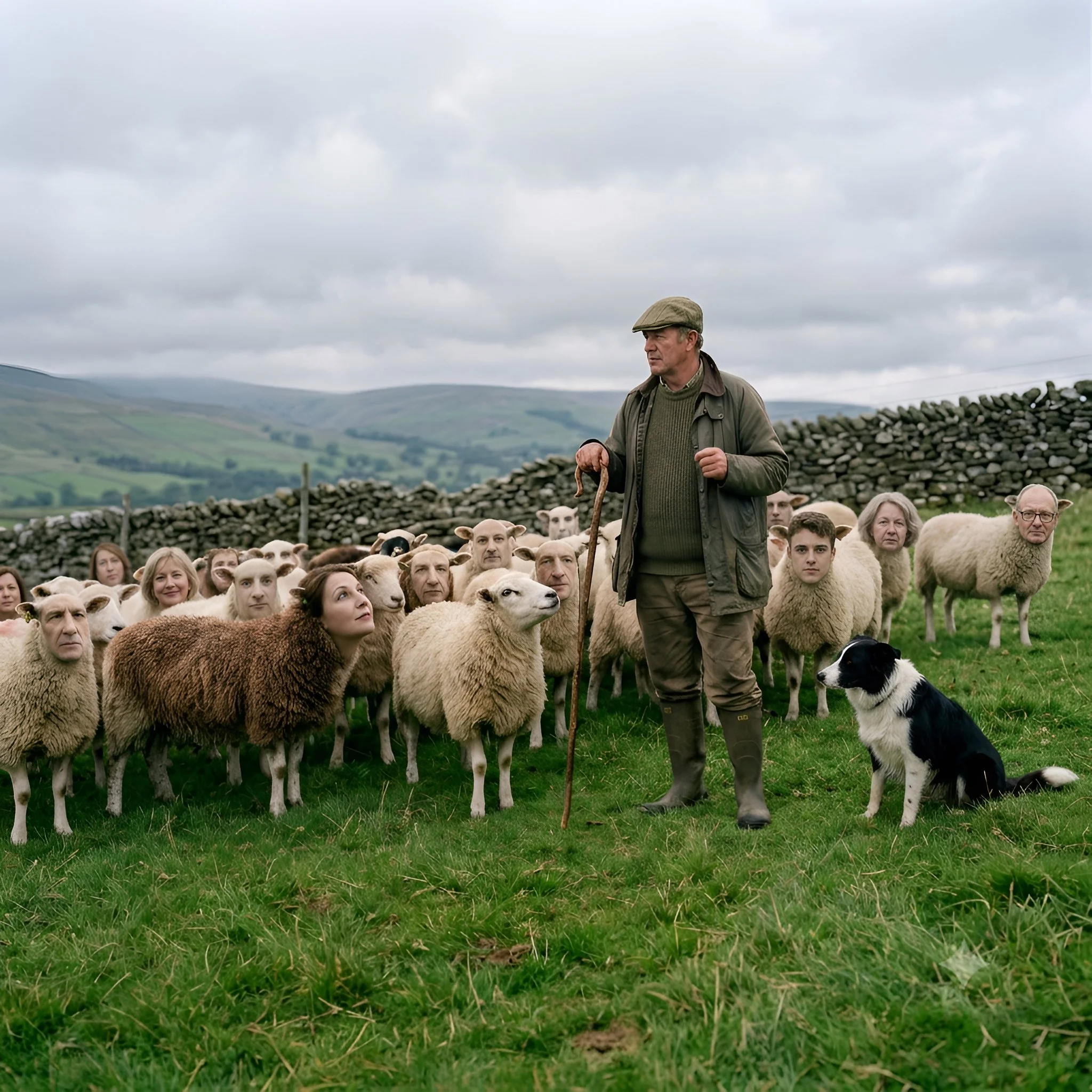
We have lost the concept of being sheep under the protection of a shepherd within the church and the concept of submission has become offensive.
The concept of sheep and shepherds are mentioned hundreds of times throughout the Bible. It is one of the Bible’s most prominent metaphors.
In the Old Testament, many of the central figures of the Bible were literally shepherds tending literal sheep BEFORE they led God’s people.
Cain was a farmer, his brother Abel was the first recorded shepherd in the Bible. He offered God the better sacrifice when he offered the “firstborn of his flock and the fat portions” as a sacrifice to God.
Abraham was a wealthy pastoralist (a livestock farmer or herder who raises domesticated animals—such as cattle, sheep, goats, or camels—as their primary economic activity. They are characterized by moving their herds across large tracts of land to find fresh grazing and water sources). As a pastoralist, he was a shepherd owning massive flocks of sheep and goats, but he also managed a large household with many other hired shepherds.
Abraham’s son Isaac, like his father, was a wealthy pastoralist and herder.
Isaac’s son Jacob was a shepherd who spent decades herding and breeding flocks, first for his uncle Laban in Haran in exchange for marrying Rachel and Leah, and then having his own flock.
Rachel, Jacob’s wife, was noted to have tended her father Laban’s sheep.
Moses was a shepherd after fleeing Egypt, he spent 40 years in the wilderness tending the flocks of his father-in-law, Jethro. This period prepared him, teaching him patience, endurance and humility that he would need when God sent him BACK to Egypt to lead the Hebrew/Israelites out.
Zipporah (Moses’ future wife) and her sisters tended their father’s flock in Midian.
King David tended his father Jesse’s flocks in Bethlehem before he was anointed king. When they went up against Goliath, he said, “What are you guys so scared of? Tending sheep, the LORD helped me kill a bear AND a lion….what does this dude have that God can’t handle?!”
Shepherding prepared him to lead and AS a leader, in Psalms 23 King David famously says, “The LORD is MY Shepherd, I shall not want. He leads me beside still water for His name sake.” He understood the protective role of a shepherd and he KNEW that God was that for him.
The prophet Amos also identified himself as a shepherd from the town of Tekoa before God called him to prophesy to the Northern Kingdom of Israel.
Psalms and the prophets are full of references to sheep and shepherds:
Psalm 23 The LORD is my shepherd
Psalm 78:52 He led out His people like sheep and guided them in the wilderness like a flock.
Psalm 79:13 We your people, the sheep of your pasture.
Psalm 100:3 We are His people, and the sheep of His pasture.
Psalm 119:176 I have gone astray like a lost sheep.
Isaiah 53:6 All we like sheep have gone astray.
Isaiah 53:7 Like a lamb that is led to the slaughter, and like a sheep that before its shearers is silent,
Isaiah 60:3 All the flocks of Kedar shall be gathered to you
Jeremiah 23:1 Woe to the shepherds who destroy and scatter the sheep of my pasture!
Jeremiah 50:6 My people have been lost sheep
Ezekiel 34:11-16 I myself will search for my sheep and will seek them out.
Micah 2:12 I will set them together, like sheep in a fold, like a flock in its pasture
(This really has nothing to do with sheep and shepherds, but yesterday, reading in Jeremiah it talked about heavenly hosts when it said the sun, the moon, and the heavenly hosts…..heavenly hosts referred to the stars. I never knew that! The New Testament gospels begin with shepherds tending their flocks at night who were visited by an angel and a heavenly host. Interesting side note.)
Back to sheep and shepherds:
Jesus referred to sheep and shepherds in his teachings.
In John 10 Jesus declared that He was the Good Shepherd, laying down His life for the sheep. He distinguishes Himself from the “hired hand” who flees when danger approaches. He also claims to be the “gate for the sheep,” protecting them from thieves and robbers. He says that His sheep hear His voice, He knows them and they follow Him.
Jesus asked Peter in John 21 if he loved Jesus. He then told Peter, if you love Me, feed My sheep or tend to My sheep.
In Matthew 9 Jesus sees the crowds as “harassed and helpless, like sheep without a shepherd.”
In Luke 15 and Matthew 18 we see the parable of the lost sheep, highlighting God’s pursuit of the lost.
In Matthew 10 Jesus sends His disciples out as “sheep among the wolves.
Matthew 25 depicts the day of judgment as separating the sheep from the goats.
Matthew 26:31 Jesus quotes prophecy, ‘I will strike the shepherd, and the sheep of the flock will be scattered.’
In Luke 12:32 Jesus says, “Fear not, little flock, for it is your Father’s good pleasure to give you the kingdom.”
In the book of Acts, Luke tells leaders of the church to shepherd the church (the flock).
In 1 Peter, Peter urges the elders to care for the flock while looking to the “Chief Shepherd,” Jesus who is the overseer of our souls.
Hebrews 13:20 refers to Jesus as the “Great Shepherd of the sheep.”
And in Revelation 7:17, the Lamb is identified as the one who will “be their shepherd.”
We have focused SO much (at least in America) on our “personal relationship with Christ” that we have neglected to see the bigger picture, that we, collectively, are THE BODY, the flock of Christ. Any body that is not unified, is broken and not functioning as it should.
Without any given part of my physical body, I will experience dysfunction in the way it operates, the same is true spiritually of the body of Christ.
Does God want a PERSONAL ONE ON ONE relationship with us? ABSOLUTELY He does. He also wants absolute UNITY within His body. We can’t effectively have one without the other.
When ANY part of the body is missing or does not bring its supply, the body suffers. When I get a cold, it doesn’t just affect my nose or my mouth as I cough and sneeze. Having a cold depletes me of energy and makes everything I do harder.
If EVERYONE brought the first fruits of their harvest to the body, I dare to say we would have no unmet needs in the body. If those who are CAPABLE of working and providing for themselves are not working, I think it should be appropriate for elders in the body to come alongside them, figure out what is needed to get them living up to their potential and help them get back on their feet, working as they ought.
It takes humility to be open to receiving feedback from others. In order to receive feedback in a way that benefits you, you must be willing to accept ALL feedback, whether you believe it is necessary or not, with gratitude and not offense.
A wise counselor once told me, when someone offers you feedback, thank them and take it home. Sit with the LORD about it. If you find truth in it, ask the LORD to help you apply it to your life. If not, without a word, you can let it go. Just because you accept feedback, doesn’t mean you have to keep it.
Feedback is one of the most incredible gifts another human can offer you.
Ask the LORD if there is anything you can do to
become more open to receiving feedback.
Proverbs 1:5 “A wise man will hear and increase learning, and a man of understanding will attain wise counsel.”
Proverbs 9:8-9 “Do not correct a scoffer, lest he hate you; rebuke a wise man, and he will love you. Give instruction to a wise man, and he will be still wiser; teach a just man, and he will increase in learning.”
Proverbs 15:31 “The ear that hears the rebukes of life will abide among the wise.”
Proverbs 19:20 “Listen to counsel and receive instruction, that you may be wise in your latter days.”
There is an Arabic proverb that says “Consult a person who has made a thousand mistakes, for he will advise you wisely.”
I asked my younger daughter recently if my older daughter is holding anything against me that she knows of, because she hasn’t told me. My younger daughter said, “She may still have hard feelings about things that happened when we were kids.”
I’ll be the first to tell you that I made a LOT of mistakes as I was raising my children, and I was probably too insecure to receive the feedback others offered. I wish I knew then what I know now. I’m much wiser and I would DEFINITELY do things much differently if I had it all to do again.
I hope that my children will be willing to learn from the wisdom I’ve gained having made many mistakes….or even that through these blog posts there will be someone willing to learn from my mistakes rather than foolishly making their own.
I used to jokingly say, “It takes a village to raise a Donna.” I think the same is true of us all.